The Dove on Main Street
I was walking down Main Street in Grapevine, minding my own business, when I nearly stepped on her.
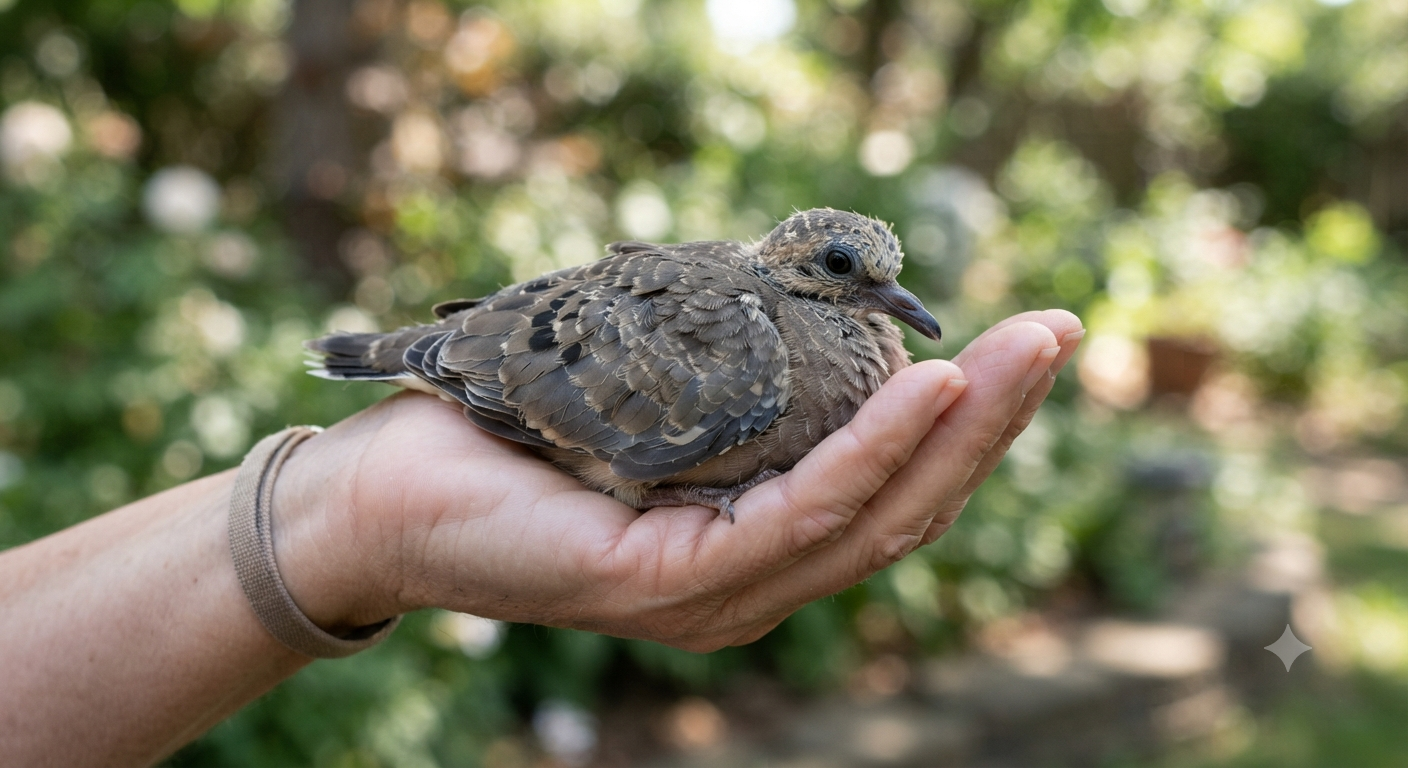
A nestling. Small enough to sit in one palm with room to spare, nowhere near ready to be out here on her own. I looked up and found the nest almost right away, tucked on a ledge above the storefronts, the kind of spot that needs a very particular ladder and someone’s permission to reach. I had neither. So there we stood, the two of us, on a sidewalk in the middle of a Texas summer, each a little out of our depth.
She looked all right. No blood, nothing obviously broken, just impossibly small and in entirely the wrong place. I scooped her up and carried her the rest of the way home, feeling quite proud of myself.
That pride lasted about twenty minutes.
The part I got wrong
It was hot, she was a baby, and every maternal instinct I own said give the child something to drink. So I did. Just a little water, off my fingertip.
Then I sat down and actually looked up what you’re supposed to do for a baby bird, and the first sentence stopped me cold: never give it water. Not a little, not a drop. They can’t swallow the way we do, and it can go into the airway instead of down. It can kill them.
I sat there holding a bird I had just tried to rescue and had very nearly finished off myself, out of pure love and zero information.
I want to leave that part in, because it’s the most useful thing in this whole story. My heart was in exactly the right place. My hands had no idea what they were doing. Wanting to help and knowing how to help turn out to be two entirely different skills, and loving someone doesn’t hand you the second one automatically. Sometimes the kindest thing you can do is set your good intentions down for a minute and go find someone who actually knows.
Finding somewhere to take her
I had no idea a place like this even existed, and certainly not where to find one at my age. I asked ChatGPT, of all things, and it pointed me toward the North Texas Wildlife Center, about forty minutes up the road. I called, they gave me an appointment for that afternoon, and off we went.
It was a house. A perfectly ordinary house on a perfectly ordinary street, the kind you’d drive past a hundred times without a second look and never guess what was happening inside.
A young couple was ahead of me at intake with a shoebox, and inside the box was something tiny with almost no fur to speak of. The young man turned around, entirely serious, and asked if I had a baby possum too. I told him no, just a bird, and we had a nice little laugh about the club we’d both apparently joined without applying.
The first question the woman at intake asked me was whether I’d tried giving her water.
Yes. I certainly had.
She was gracious about it, the way you’re gracious with someone who clearly meant well. Said the little one would probably be fine, and moved right along, and I have rarely been so grateful for a stranger not making a thing of my mistake.
The place smelled like exactly what it was. Incubators everywhere, keeping the babies warm. She checked my bird over from beak to tail feathers and told me she was a healthy nestling mourning dove.
Then I handed her over, walked back out to the car, and drove the forty minutes home with an empty passenger seat and a heart that was, if I’m honest, entirely too full for one small bird.
What happens after you hand one over
They sent me home with a brochure, which I read in the driveway before I even got out of the car. I’d pictured something well meaning and a bit improvised. What they’re actually running is a hospital, and a serious one. Every animal that walks or is carried through that door gets its own exam and its own plan.
- ICU and NICU. Babies and critically injured wildlife, kept warm, quiet and watched closely, with oxygen on hand if it’s needed. This is the room I was standing in.
- Step-Down Unit. Stable, but still needing regular monitoring, in cages with limited mobility so healing doesn’t get undone by one bad landing.
- General Population. No longer needing medication, just growing, and learning the survival skills they’ll actually use.
- Offsite Transition to Specialist Care. Predators, raptors and larger species move to partner facilities set up for flight training and hunting practice.
- Pre-Release. Outdoor enclosures, a wild diet, and human contact kept deliberately to a minimum, so whatever makes them wild survives the whole ordeal.
Orphans stay until they’re healthy, strong and genuinely ready. Injured adults stay until they’ve recovered. Babies are raised alongside siblings of their own kind, so they learn from each other and not from us, with toys and climbing structures built to sharpen instincts they were born with but haven’t used yet.
Their stated goal, printed right there in plain type, is to release every single animal back into its own habitat. That’s the line I couldn’t stop thinking about. Everything they do is engineered to make themselves unnecessary to that animal, as fast as possible. They warm her, feed her, teach her, and then they open the door and she never gives them a second thought. There’s a strange kind of love in that, if you sit with it long enough.
What to actually do if you find a baby bird, or any backyard baby
Here’s what I know now that I didn’t know standing on that sidewalk. I am decidedly not the expert, the people at the center are, and their intake line is at the bottom of this post. But this is the short version I wish someone had handed me before I reached for that glass of water.
- Skip the food and water. This is the one I got wrong, and apparently a lot of us do. Birds can’t swallow the way we assume, and liquid can go straight into the airway instead of the stomach.
- Feathered and hopping is usually fine. A fledgling on the ground with feathers, hopping around indignantly, is very often exactly where it’s supposed to be, with a parent watching from somewhere close by. Leave it alone and keep the pets and the well meaning children inside.
- Bare and helpless needs help. A nestling with little or no feathering that can’t perch or hop belongs back in the nest. If you can reach it, put it back. Touching it will not make the parents abandon it, that particular piece of folklore has caused more harm than it’s ever prevented.
- Nest out of reach? Call someone. Keep the bird warm, dark and quiet in a ventilated box, away from noise and pets, and get it to a licensed rehabilitator. Don’t try to raise it yourself. It’s illegal for most species, and it very rarely ends the way you’re hoping.
Birds get most of the attention, understandably, but they’re not the only backyard baby that shows up looking abandoned when it isn’t.
- A baby rabbit, alone in a shallow nest of grass. This is almost always intentional. Mother rabbits visit only twice a day, at dawn and dusk, so a nest that looks abandoned all afternoon is usually just fine.
- A baby squirrel on the ground, uninjured. Give the mother a chance first. Place it in a shallow box near the base of the tree and step back for a few hours before calling.
- A fawn curled up, seemingly alone. Mother deer intentionally leave fawns hidden for long stretches. A still, quiet fawn is not an abandoned one.
- An opossum found alone. If it’s under about seven inches long, not counting the tail, it likely fell off mom’s back and needs help.
The rule underneath all of it is the same one I learned the hard way. Our job is rarely to fix it ourselves. Our job is to notice, to leave well enough alone when that’s the actual kindness, and to know who to call the moment it isn’t.
The people who do this
The North Texas Wildlife Center is a genuine nonprofit, a 501(c)(3), devoted to the rescue, rehabilitation and release of injured and orphaned wildlife across our part of the state. Bats, beavers, bobcats, coyotes, fawns, foxes, hawks, opossums, owls, raccoons, skunks, songbirds, squirrels, turtles, waterfowl, and, as of one Tuesday afternoon, a nestling mourning dove from Main Street in Grapevine.
Their own brochure says it about as plainly as it can be said. We exist because of your support. Help us, help them.

Hand-feeding, the round-the-clock kind

An orphan small enough to fit on one finger

A songbird, steadier than mine ever looked

Yes, they take those too
Not photos from this particular visit. Stock images standing in for the kind of care I watched happen behind that brochure.
If something in you stirred when you read this and you’d like to help in any way, their contact information is just below. I’m not affiliated with them in any way. I’m just a woman who was grateful to have somewhere to take a baby bird, knowing she’d be well cared for.

Ways to Help: North Texas Wildlife Center
- PayPal: paypal.com/donate/?hosted_button_id=R7LJ2D588PRAE
- Venmo: @NTXWC
- Cash App: $NTXWC
- Amazon wish list and Walmart wish list, linked on their site
- Mail: PO Box 830212, Richardson, TX 75083
- Volunteer: volunteer@ntxwildlife.org
- General: info@ntxwildlife.org
- EIN: 61-1725985
Found an animal that needs help right now? Text or call the intake line at 469-901-9453. That line is kept clear for active emergencies only.
I keep thinking about how close I came to being the reason she didn’t make it. Not through carelessness. Through care, applied with complete confidence and total inaccuracy, which if I’m honest describes a fair amount of my mothering too, looking back.
There’s a version of this everywhere in our lives, not just out here in the yard. We see something small and struggling, and we reach for it, and we hand it the thing we would have wanted at that age. Sometimes that’s exactly right. And sometimes what it actually needs is a person with real training, a warm incubator, and forty minutes of our willingness to drive it there ourselves.
I’m so glad places like this exist, tucked into ordinary neighborhoods where you’d never think to look. Somewhere between what I wanted to do for her and what she actually needed, there was a house with the lights on, and someone inside who knew the difference. May we all be so lucky, and so willing to ask.
North Texas Wildlife Center · ntxwildlife.org · Intake 469-901-9453